
India's economic growth, which dipped to 9-year low of 6.5 per cent in 2011-12, is expected to rebound from October, Chief Economic Advisor Kaushik Basu said.

Prime Minister Manmohan Singh on Saturday asked European countries to take firm steps to fix the continent's financial mess, which was hitting India's economic growth and dampening global markets.

India's peak power demand is projected to hit 270 GW this summer, surpassing last year's record of 250 GW.
The Indian rupee experienced a significant surge against the US dollar following the Reserve Bank of India's measures to restrict banks from onshore forward markets. Despite this, the rupee remains under pressure from foreign capital outflows, a strong dollar, and rising crude oil prices.

India has managed high government debt-to-GDP, a slowing domestic revenue engine, lower household savings and a more hostile geopolitical environment separately in the past. But together, they threaten to undo the growth narrative on which today's optimism rests, warns Debashis Basu.

The cost of the war is being counted not in the corridors of power in Washington or Tehran, but in Firozabad's darkened furnace rooms, Howrah's idle casting sheds, and a barbershop in Kochi where the wait is suddenly, inexplicably, an hour long, notes Prem Panicker in his must read blog on the Iran War.

'The fiscal deficit target of 3.9 per cent of GDP seems achievable.'

The business value of the league, popularly called the IPL, surged to a record $18.5 billion last year, U.S.-based investment bank Houlihan Lokey says.
'Nations like India with high inflation and public debt should be cautious'

Emphasising that focused efforts are needed to ensure economic growth and creation of jobs in US, the White House has said that necessary measures should be taken in this regard.

Haryana Chief Minister Nayab Singh Saini criticised the Aam Aadmi Party's governance in Punjab, citing issues such as drug addiction, crime, and financial instability. He promoted the BJP as an alternative, highlighting their development agenda and commitment to fulfilling promises.

India's real GDP grew 8.2 percent in the second quarter of 2025-26, up from 7.8 percent in the first quarter and 7.4 percent in the fourth quarter of the last fiscal.
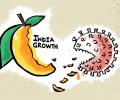
The economic growth may have slowed to 3.5 per cent in fourth quarter of 2021-22 from 5.4 per cent in the previous three-month period due to the impact of higher commodity prices on margins, decline in wheat yields and on higher base, Icra Ratings said on Monday. The agency said the hiccups in the recovery of the contact-intensive services attributable to the third wave of Covid-19 in the country may have also affected the economic growth in the quarter. Even the gross value added (GVA) at basic prices (at constant 2011-12 prices) in Q4 FY2022 seems to have eased to 2.7 per cent from 4.7 per cent in Q3 FY2022, it said.
The US-India Business Council on Monday termed growing ties between Washington and New Delhi as a 'catalyst' for continued economic growth, even as a former US envoy wanted the two countries to go beyond rhetoric.

Trump may strike. He may announce productive talks and extend again. He may do both at the same time. Iran will not open the Strait on someone else's terms, so no matter what happens, that problem will remain unsolved. And the IRGC will still be collecting its $2 million toll from every ship bold enough to ask permission to pass.

Defence Minister Rajnath Singh addressed a rally in West Bengal, promising to tackle crime and joblessness if the BJP comes to power. He criticised the current government for allegedly favouring criminals and failing to protect women.

The Indian government has expressed its disagreement with the IMF staff's 'baseline' assumption that the 50 per cent US tariffs on its goods exports 'would remain in place indefinitely', based on which the staff pegged the country's GDP growth at 6.6 per cent this year, and pared its 2026-27 projection by 20 basis points to 6.2 per cent.

Trade deals ease risks for Indian equities, but weak demand and stretched valuations raise questions over whether optimism -- especially in smallcaps -- can turn into a sustained bull run, points out Debashis Basu.
Economic growth and strong offerings by computer assemblers will drive the demand for personal computers, expected to grow at 18 per cent, in the country in 2003, according to Gartner Dataquest study.

In a world fractured by uncertainty, India stands out for its policy consistency, paired with sustained ambition, points out Pritam Banerjee.
Union Minister Giriraj Singh has accused West Bengal Chief Minister Mamata Banerjee of protecting infiltrators from the Muslim community for political gain. He also alleged corruption and economic decline under the TMC government.

Tamil Nadu Chief Minister M K Stalin on Saturday claimed that Governor R N Ravi 'insulted' the gubernatorial position he holds, by not reading out the speech at the commencement of the assembly session.

Government schemes such as the PM E-Drive initiative, with allocations of around Rs 2,000 crore for charging points deployment, are helping accelerate rollout

The consumer price index (CPI)-based inflation hitting an all-time low in October would encourage the six-member monetary policy committee (MPC) of the Reserve Bank of India (RBI) to cut the policy repo rate in its upcoming December 3-5 meeting. However, the July-September GDP growth, expected to be above 7 per cent, may act as a deterrent.

The DMK party in Tamil Nadu has released its manifesto for the upcoming Assembly elections, promising a range of welfare measures focused on women, education, and economic development, including financial assistance and job creation initiatives.

In modern investing, transparency is more valuable than zero fees and not all investing app score big on this front, says Ramalingam Kalirajan.

Prime Minister Narendra Modi addressed the Israeli Parliament, reaffirming India's support for Israel in the face of terrorism and expressing support for the Gaza peace initiative.

Benchmark stock indices Sensex and Nifty closed higher on Thursday, helped by a rally in blue-chip Larsen & Toubro and the Economic Survey projecting the GDP growth of 6.8-7.2 per cent for the next fiscal.

India's economic growth could fall to 5.5 per cent this fiscal before seeing gradual recovery next year, a RBI-sponsored survey said.

External Affairs Minister S Jaishankar affirms India's self-determined and 'unstoppable' rise, emphasising the nation's strategic growth and role in the Indian Ocean region amid evolving global dynamics.

The purge in Washington does not pause the war. Strikes continue, Hormuz remains closed, and Brent crude is still dancing around $109 a barrel. For India, the command chaos in the Pentagon is another layer of uncertainty piled on five weeks of conflict that was already straining every buffer Delhi has.

India's economic growth is expected to be lower at 6.3 per cent this fiscal compared to the RBI's projection of 6.5 per cent, a SBI Research Report said on Thursday. The report pegged the first quarter GDP estimate at around 6.8-7 per cent, mainly due to muted private capex.

Asian Development Bank (ADB) on Friday warned that India's limited crude oil reserves of about 100 million barrels - sufficient for only 40-45 days of consumption - leave the country particularly vulnerable to supply disruptions through the Strait of Hormuz amid the ongoing war in West Asia.
Terming the Mumbai blasts as an attack on India's economic growth, Union Minister and Nationalist Congress Party leader Praful Patel on Thursday said the Centre and state governments should set up a specialised force to deal with such situations in big cities.

The way India dealt with the impact of the global economic crisis and failure of the South-West monsoon was praise worthy, said Prime Minister Manmohan Singh in Lok Sabha on Friday.

India's clean energy technology industry is experiencing rapid growth, with recruitment increasing significantly due to policy support and investments in green energy. However, challenges remain in talent availability, skills alignment, and gender diversity.

The Indian economy recorded a six-quarter high growth of 8.2 per cent in July-September, as factories churned out more products in anticipation of a consumption boost from the GST rate cut, according to government data.

Skoda India is focusing on cleaner fuel options, including CNG and EVs, while compact SUV Kylaq drives volumes, expands first-time buyers and strengthens the brand in India's competitive market
Deloitte India on Thursday projected India's economy to grow 6.7-6.9 per cent in the current fiscal amid buoyant demand and policy reforms. Indian economy grew 7.8 per cent in the April-June quarter of current fiscal.
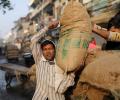
India's economic growth forecast for 2025 has been revised downward to 6.3 per cent, and despite a projected moderation, the country remains one of the fastest-growing large economies, supported by resilient consumption and government spending, the United Nations has said.
